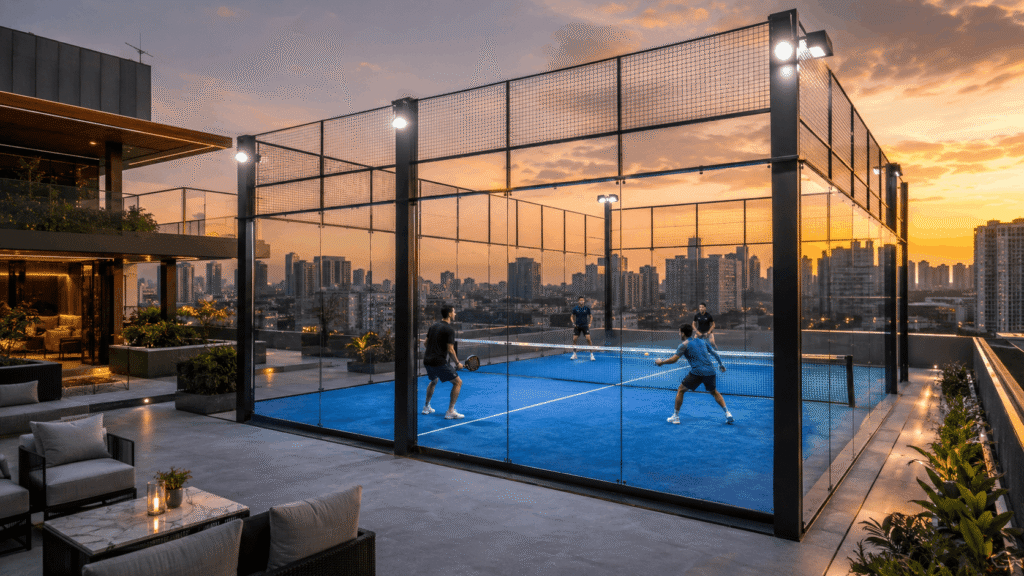
Turning unused rooftops and terraces into active sports spaces is becoming a practical solution in crowded Indian cities. Among these, padel courts are gaining attention for offering a compact yet premium sporting experience. However, building one on a raised structure requires far more than just installation; it involves engineering checks, material planning, and long-term safety considerations.
Here Are 5 Practical Things You Must Know Before Installing A Padel Court On A Rooftop!
1) Structural Strength Of The Building Is The First Priority
The first step is not design or flooring, it is checking whether the building can actually carry the additional load. A padel court includes a steel-framed structure, tempered glass walls, synthetic turf, lighting poles, and dynamic loads from players running and jumping during rallies. This is exactly why the structural load padel court rooftop assessment is non-negotiable. A licensed structural engineer must verify slab capacity, beam strength, and load distribution. In older buildings, reinforcement may also be required before installation can even begin.
2) Proper Design & Space Planning Is Essential
A rooftop is rarely a “blank” space, so measurements must be precise. A standard padel court requires fixed dimensions, but rooftops often have lift rooms, water tanks, or parapet walls that interfere with layout planning. Wind exposure is another real factor at height, especially in open terraces, where gusts can affect ball movement and glass stability. That’s why experienced providers, such as a Padel Courts Manufacturer in India, usually redesign structural anchoring, fence height, and glass thickness specifically for rooftop conditions rather than using ground-level designs.
3) Waterproofing & Drainage Cannot Be Ignored
Water management determines how long the installation lasts, as without proper waterproofing, rainwater can seep into slabs and weaken the structure over time. A layered waterproof membrane is usually installed below the court base. Drainage points must be strategically placed so water does not pool around corners or under synthetic turf. This is a key part of the padel court on building terrace requirements, especially in regions with heavy monsoon cycles, where water stagnation becomes a recurring issue if ignored during construction.
4) Permissions, Safety Rules, & Noise Control Matter
Before installation, approvals from housing societies, RWAs, or municipal bodies may be required, depending on the building type. Safety compliance is also strict; therefore, glass panels must be laminated and impact-resistant, fencing height must meet safety standards, and lighting must avoid spillover into nearby homes. Noise is another practical concern; repeated ball impact and player activity can travel across floors. Planning for terrace padel court installation India often includes adding sound-dampening materials and setting time restrictions for play in residential buildings.
5) Cost Depends On Design, Material, & Location
The Padel court construction cost in India is not fixed because rooftop projects vary widely. Costs increase when structural strengthening is required, when premium tempered glass is used, or when advanced LED lighting systems are installed for night play. Transporting materials to higher floors and assembling them in restricted rooftop spaces also adds to labour time. A detailed estimate from an experienced supplier helps avoid unexpected budget changes during execution.
Final Thoughts
A rooftop padel court is a smart use of urban space, but it is not a plug-and-play installation. Every layer, from structural safety to waterproofing and permissions, directly affects durability and usability. Working with a skilled Padel Courts Manufacturer in India like Afi Padel ensures the project is planned with real engineering inputs, not just surface-level construction ideas, making the court stable and usable for years. Contact us!